Think about the last time someone told you exactly what to do and how to do it. Did it make you feel energised? Or did it make you feel more like an AI agent?
If you answered the latter, you are not alone. Millions of Millennials and Gen Z employees [1] now comprise the majority of the workforce, and they are engaged by a different type of leadership [2]. The old model of management (tell, direct, evaluate, repeat) is breaking down, and those who still rely on it are seeing the costs manifest in rising turnover, disengaged teams and stagnating performance.
There is a better way forward by starting with a skill everyone can learn: coaching.
Why Should Leaders Develop Coaching Skills?
Generational change is one of the most powerful drivers reshaping leadership expectations. Today’s employees, particularly Millennials and Gen Z, tend to be motivated by autonomy, growth and the belief that their work matters and their voices are heard. Being “told” what to do without context, trust or development opportunities rarely resonates.
However, adopting a coaching mindset is only about catering to generational preferences. It helps you unlock the potential of your people. McKinsey [3] observed that the highest-performing leaders focus on making their team and others successful.
A coach prioritises developing the capabilities of those they work with. In doing so, they continuously improve individual and collective performance [4]. Additionally, when managers are no longer bottlenecks needed for every decision, productivity improves as staff can work more quickly and independently. Other byproducts include higher engagement, lower turnover and a culture where the workforce wants to actively contribute. [5]
Coaching skills are essential for any leader or organisation serious about sustainable performance.
What Is the Difference Between a Manager and a Coach?
I believe the most observable difference is that someone who coaches leads with questions. They believe the other person already has the answers, and they focus on helping that individual find them. The shift from command-and-control to curious-and-empowering shifts the dynamic between a leader and those they work with, as well as overall team performance. Other variances include: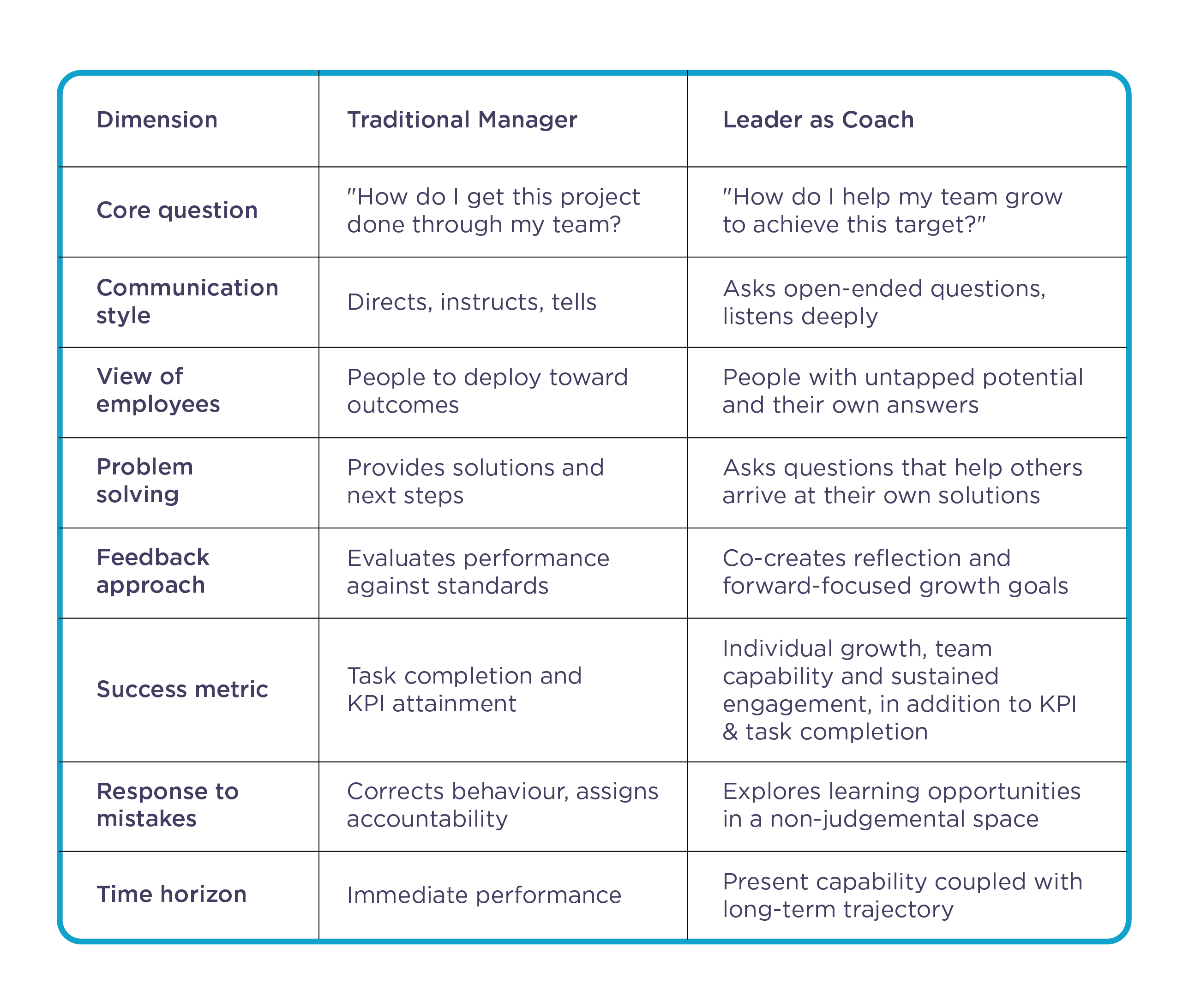 I recommend five foundational shifts to ignite a new mindset.
#1 – Believe in others’ capability
Trust that the person in front of you knows how to solve the challenge that’s been raised. Your job is to help them access what they already know or identify the resources they can use to reach a resolution.
#2 – Practice active, deep listening
Listen to understand, rather than respond, advise or redirect. Real listening is rare and profoundly impactful.
#3 – Embrace curiosity over direction
Ask open-ended, thought-provoking questions that spark insight and break habitual patterns of thinking.
#4 – Cultivate psychological safety
Create a non-judgemental environment [6] where staff can speak honestly, take risks and learn without fear.
#5 – Focus on the future & goals
Stay solutions-centric. Coach toward better outcomes and future improvements rather than dwelling on past challenges.
How Can L&D Teams Embed Coaching Skills into Leadership Development Programmes?
#1 – Get buy-in by connecting coaching culture to performance outcomes
When leaders see the return on investment on your initiatives, they become champions rather than skeptics. Tie your training initiatives directly to priority business outcomes, such as performance metrics or engagement and retention rates.
#2 – Build a multi-phase plan tailored to your organisation
Successful programmes begin with awareness and internal shifts and then layer in personal and team development. Identify phases that move leaders from understanding coaching to actively practising it.
#3 – Take a system-wide approach
A coaching culture [7] must be woven into more than your leadership training sessions. Integrate it into performance management, 1:1 frameworks, team rituals and leadership expectations.
#4 – Use frameworks that make coaching actionable
When individuals communicate in ways that resonate with their colleagues and direct reports, they are more likely to have constructive conversations that yield desired results. Using Emergenetics [8] and our Attributes in Action guides, managers and executives gain easy-to-apply tools for delivering feedback and supporting employee growth.
An important caveat: coaching is situational
Like all leadership styles, coaching is most powerful when applied with judgement. It is not a one-size-fits-all solution for every moment.
For example, in an emergency, people need clarity and direction, not open-ended questions. Command-and-control techniques have their place, and a skilled leader knows the difference. Help executives and managers role-play and reflect to strengthen their situational awareness, so they know when to coach, when to direct and when to simply listen.
Amplify Your Company’s Capacity for Coaching
These skills are not just for executives, leaders or HR professionals. They are life skills, and they transform organisational performance. The companies that build coaching competencies into their leadership development programmes will be the ones that attract, retain and develop the talent needed to compete in today’s environment and in the future of work.
What other skills do your leaders need to thrive? Download our guide [9] to find out…
 [9]FAQs
What are coaching skills for leaders, and how do they differ from traditional management skills?
Coaching skills are a set of interpersonal capabilities that help unlock the potential of others. While traditional management focuses on task completion and performance oversight, a coaching approach creates the conditions for people to think, grow and solve problems for themselves.
Importantly, these skills don’t replace management. They expand a leader’s repertoire. The most effective leaders know when to coach, when to direct and when to simply listen.
How can I integrate coaching skills into our existing leadership development programme?
Coaching skills can be woven into existing frameworks by focusing first on awareness and mindsets. Using tools like the Emergenetics Profile [10], leaders can understand their own Thinking and Behavioural tendencies and the preferences of their team members.
Then, focus on skill-building by introducing core competencies like listening and questioning through facilitated sessions, role play and on-the-job learning. Be sure to embed coaching into day-to-day leadership rituals and accountability metrics.
How does the Emergenetics Profile help leaders develop a coaching mindset?
Self-awareness [11] is foundational for effective coaching. Before a person can guide others well, they need to understand how they themselves think, communicate and behave.
The Emergenetics Profile builds this awareness by surfacing strengths and blind spots, helping individuals understand how they are alike and different from the people they are leading. A growth conversation is far more effective when a manager can adapt their questions and approach to the preferences of the person in front of them.
What does a coaching culture look like in practice?
In organizations where it has taken hold, you’ll notice a few differences in everyday interactions: leaders ask more and tell less, team members feel safe raising problems without fear of judgement and conversations about performance are forward-focused rather than backward-pointing.
How can I introduce coaching skills to my leaders, managers and executives?
Every organisation is different, so the right engagement depends on where you are today. Many successful coaching skills engagements follow a similar arc:
- Discovery conversation: We start by understanding your goals, your current leadership development programming and the outcomes you want to achieve.
- Emergenetics Profiles: Participants complete the Emergenetics assessment [12], which becomes the foundation for self-awareness, coaching conversations and team dynamics discussions.
- Workshop: Leaders experience Emergenetics in a group setting, building a shared language, appreciating cognitive diversity and beginning to apply coaching behaviours in practice.
- Ongoing integration: Coaching skills are embedded into leadership rituals, performance conversations and team processes with supporting resources (like our mobile app and Attributes in Action guides).
- Certification: For organisations ready to build internal capability, selected practitioners move through the Emergenetics Certification programme to sustain and scale the work independently.
If you’d like help developing a coaching culture in your organisation, let’s connect. Fill out the form below to speak with our team!