
Why Smart Leaders Fail to Communicate: What Translation Looks Like in Action


You’ve probably watched this scene play out before. An executive kicks off a meeting, often saying all the “right” things about transformation and alignment. They have a strong presence and speak with clarity. Their presentation reinforces valid, important points.
And somehow the energy feels muted. Motivation and engagement remain flat. Skepticism fills the hallways (or Zoom rooms), and the metrics these leaders are striving to improve don’t budge.
Communication breakdowns in organizations are common and costly, and they’re one of the primary reasons I’m asked to train a group of executives.
For my fellow Learning & Development (L&D) and Human Resources (HR) professionals, here are a few tips to adapt leadership communication training to build the skills individuals actually need to engage and motivate employees.
Why do leaders struggle to communicate effectively?
In the past, communication skills training often focused on delivery, how to craft a message with clarity and how to present with confidence. These are valuable capabilities, and they don’t fully address the nuanced challenges leaders face today.
The modern workforce is not a single audience. It’s a collection of people with different Thinking and Behavioral preferences, generational expectations, cultures, experience levels and contexts. No matter how polished the delivery, a person who shares information in the same way with everyone will leave most of their audience behind.
If you need some proof, take a look at our Director of Research’s article.
Great communicators embrace a skill I call translation.
What does translation mean in leadership?
Translating: The capacity to successfully transfer meaning, intent and tone across media and people.
Translation operates on two levels: an interpersonal and a systemic approach. Effective leadership communication training should develop both competencies:
Human translation
This ability bridges understanding across generations, functions, thinking and behavioral styles as well as lived experiences. Individuals with this skill recognize that the same words land differently depending on who receives them, and they adapt accordingly without losing the meaning or integrity behind the message.
Systems translation
This ability allows people to convert organizational vision, strategy and purpose into language and actions that are relevant and meaningful for each team. It’s the difference between saying “Here’s what the company is doing” and “Here’s what this shift means for your work specifically.”
Together, these two capacities empower leaders to speak multiple organizational “languages.” They can engage a data-driven analyst and an empathic relationship builder with the same core message because they know how to find the version that resonates with each person. They can connect a frontline team’s daily work to a long-term strategic shift in ways that feel genuine.
Being a translator is what allows executives and managers to strengthen alignment and sustain engagement through complexity and change.
Organizations are 3 times more likely to succeed in major change when employees are fully bought in, and change initiatives are 5.5 times more likely to fail without visible leadership and effective communication.
What does effective leadership communication look like in action?
Translators:
- Adapt their style to the audience without losing substance
- Connect team and individual work to organizational vision clearly and regularly
- Bridge understanding between departments, generations and functions
- Listen and check in for comprehension rather than assume alignment
- Make guidance and concepts tangible through stories, analogies and examples
None of these behaviors require a charismatic personality or even a gift for public speaking. They require self-awareness, curiosity about the people being led and the disciplined practice of putting the audience before the message.
Those are trainable capacities, which is good news for L&D!
How can you improve communication skills in your leadership development programs?
The most effective leadership communication training helps participants first understand who they’re speaking to and then provides tools to flex to their people’s needs.
Here are four shifts to consider:
1. Move from message to meaning
Train people to start with the question: “What does this change mean for this particular person or team?” before “What do I need to say?” The reframe moves from broadcast to dialogue and increases the likelihood that a message is understood and acted on.
2. Build Thinking and Behavioral fluency
People think, process and respond differently. Leaders who understand those distinctions and meet people where they are at will engage their audiences. Tools like Emergenetics help managers get a clear picture of their own communication preferences and the needs of their employees and colleagues.
3. Practice connection before direction
Once leaders recognize their audience’s interests and preferences, provide opportunities to practice adjusting their style while maintaining message clarity and integrity. By weaving role-playing and peer feedback into your leadership development programs, you can upskill participants with enhanced translation skills.
4. Prioritize listening
Effective communication is not only top-down. To get employee buy-in, staff must also feel heard and supported. In addition to helping leaders flex their approach, make sure you’re training them to listen and solicit feedback as well.
How can Emergenetics support leadership communication training?
I often talk about communication skills through the lens of “Me, We and Us.” In practice, that looks like asking:
How do I (Me) need to translate information to help my team (We) perform to the best of their ability so our whole organization (Us) can thrive?
Emergenetics provides the tools to do exactly that. The Emergenetics Profile reveals an individual’s Thinking and Behavioral preferences across seven Attributes, offering a lens to view the communication tendencies within their teams.
When people understand these nuances, they start making deliberate choices about how to frame, deliver and follow up on their messages. That might include weaving in statistics for the Analytically inclined, noting next steps for Structural thinkers, telling a story for those with a Social preference and brainstorming “What if’s” with Conceptual thinkers.
From the lens of Expressiveness, it may involve providing information in advance before offering a forum to discuss the change together. Speaking to Assertiveness preferences may include inviting questions and engaging in debate, and honoring Flexibility may come from stating what’s firm and what’s undecided.
That’s just a glance at how the Attributes can shape your communication! In leadership development programs, we expand on these tips, so leaders gain a host of new tools to honor every preference. That way, they can effectively adapt their approach and motivate their staff.
What’s one way to get started?
Try this activity with your leadership cohort to surface development gaps.
The Translation Audit
Ask each person to identify a recent communication they delivered and have them respond to four prompts:
- What audiences were in the room or in the email? What do you know about how each group thinks, processes and relates to organizational change?
- What aspects of the message were non-negotiable? Where did you have flexibility to adapt framing, tone or emphasis?
- How did you check for comprehension or alignment afterward? What did you learn?
- If you were to deliver the same message again, knowing what you know now, what would you do differently?
In the debrief, look for those who struggle to identify distinct audiences or who default to “I just told everyone the same thing.” Those are great development opportunities!
The next move is yours
The pace of organizational change and the diversity of today’s workforce make effective communication more important than ever. By bridging understanding across differences, connecting vision to daily work and adapting without losing substance, leaders will build trust, sustain engagement and move organization forward.
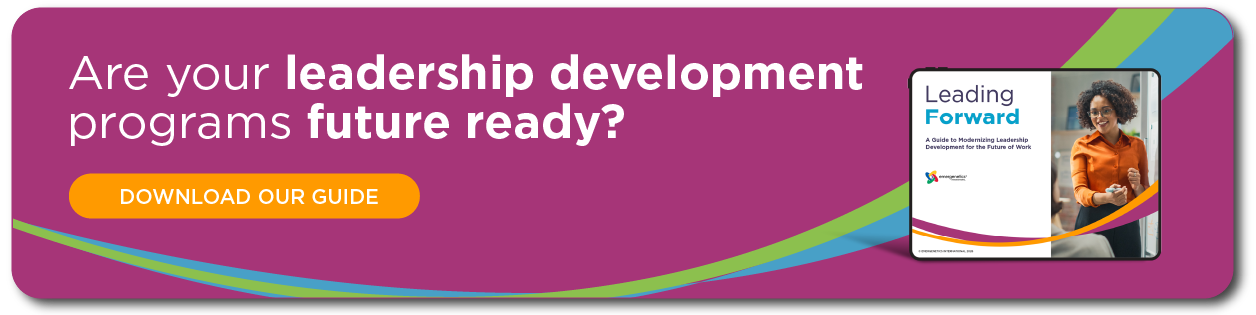
Get more strategies to support your leaders in our guide, Leading Forward!
FAQs
Q: What is leadership communication training, and why does it matter?
A: Leadership communication training develops a person’s ability to convey meaning, direction and vision in ways that are understood and acted on by distinct audiences. It matters because strong leaders with a clear strategy can still lose their teams if they don’t know how to translate that vision into relevant, resonant language for the people they lead.
Q: What are the most important leadership communication skills to develop?
A: The most important communication skills for leaders include audience awareness, Thinking and Behavioral agility, active listening and the ability to connect organizational vision to individual context.
Q: How is leadership communication skills training different from public speaking training?
A: Public speaking focuses on how someone delivers a message, including tone, pacing, presence and structure. Communication skills training addresses who the leader is communicating to, how different audiences receive information, how to adapt their approach without losing the substance of what they need to convey as well as listening.
Q: How can Emergenetics support leadership communication skills training?
A: The Emergenetics Profile gives leaders a concrete framework for understanding the Thinking and Behavioral preferences within their teams and what that means for their communication styles and needs. Embedded in leadership development programs, it helps participants identify their own tendencies, adapt to reach different audiences and develop the “human translation” skills that turn a message into shared meaning.
Q: How do I know if my leaders need communication translation training?
A: Common signs include change initiatives that stall despite clear direction from the top, engagement survey results that reflect confusion or disconnection and leaders who report “I keep repeating myself and nothing changes.” If executives and managers are communicating yet not connecting, they may need better translation skills.
Ready to boost communication skills for your leaders? Fill out the form below to connect with our team today!
 Print This Post